To listen and to hear

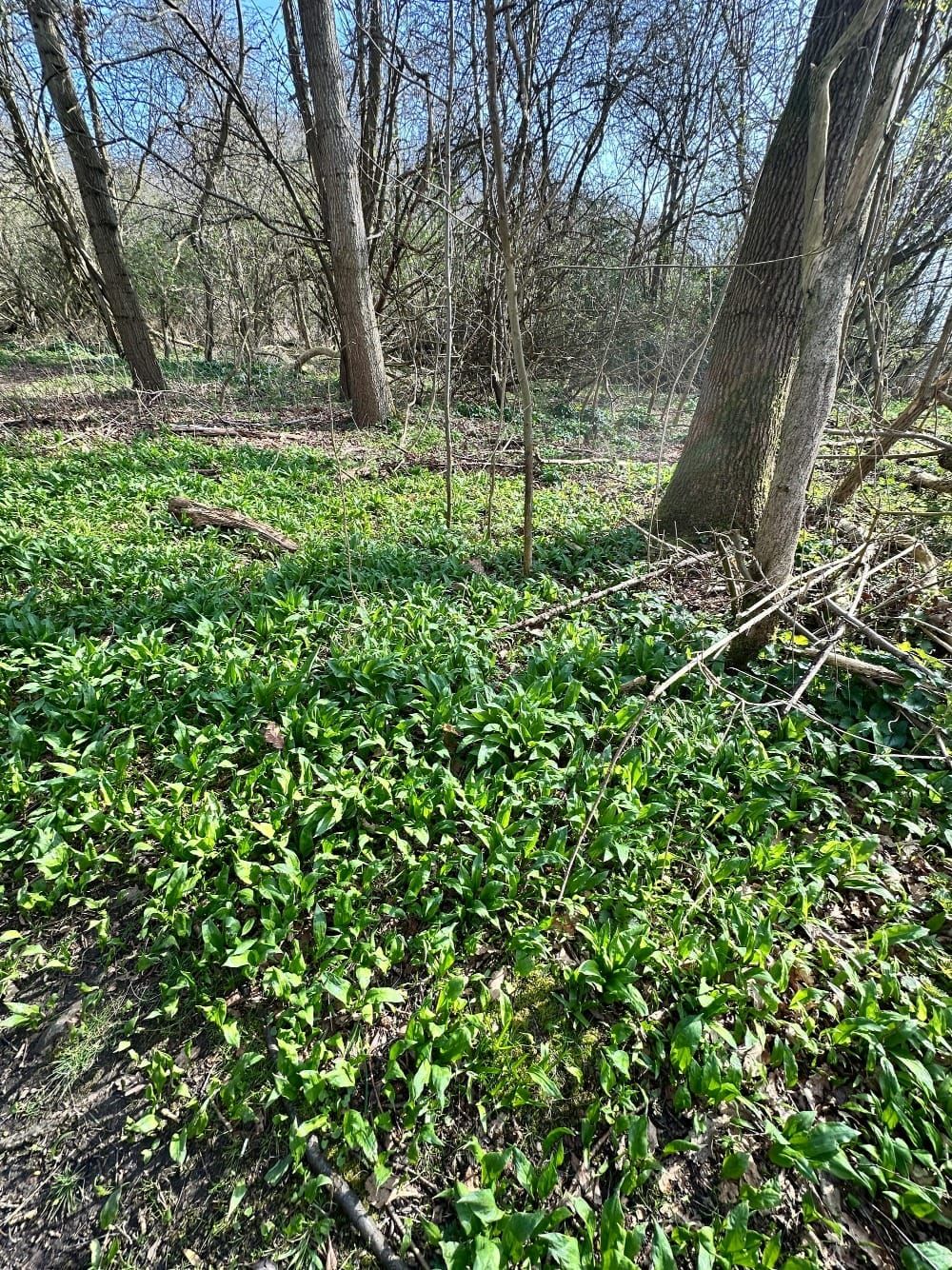
In my favourite bit of woodland, where no one ever ventures, far from the hordes ascending Arthur’s Seat, a patch of wild garlic grows every year, a verdant carpet announcing its arrival with an olfactory riot. My friend and I — a friend with whom I often share these woodland walks in pursuit of elusive water rails and kingfishers — have taken to calling this stretch of wild garlic “our patch” out of habit, even though it is not ours at all. We are guests. Invited in. Afforded the great privilege of an otter sighting, a meadow humming with the activity of bees and field mice, a handful of deliciously fragrant wild garlic.
When I take these walks alone, every step is punctuated with sounds that feel part of me: the familiar crunch of twigs and loam as the trees creak and heave a bodily sigh like tired bones; the rhythmic hooting of a wood pigeon reliable like a heartbeat; the rush of a stream, the forest’s circulatory system. If I am the forest and the forest is me, am I really a guest? Or am I at home?
In Wolof, instead of saying “I’m fine”, one says, literally, “I am here only.” Because to be here, to be present, is to be alive.
In the years since moving back to the UK from Senegal and re-entering a new phase in my relationship to the living world, I have been making conscious attempts to fine tune my ability to be here, to be present, to be alive. I do this by remembering how to listen.
A small thing, or so it seems. It started with leaving my headphones behind on walks, then eventually abandoning them during all outdoor exercise like running or cycling, instead focusing on birds, my own heartbeat and the smell of leaves, rather than pounding baselines to distract me from my shortness of breath and tightness of hip. Then, curiously, I began to practise sitting. On trains, on buses, in cafes, I would sit quietly. Resisting the urge to look at my phone, I would sit and listen, observe my own thoughts and my surroundings.
This became surprisingly easy. While I cannot lie and claim to pass a five hour train journey with no entertainment, I discovered that not only am I much less concerned about being “bored”, I find myself vibrating at a much calmer frequency. I no longer panic if I leave the house and realise that I’ve forgotten my headphones or that my phone is low on battery. We spend so much of our lives looking but not seeing, listening but not hearing. I want to hear what the forest is telling me. I want to hear and be here.
A few years ago, on a remote island in the Bissagos archipelago, I met a man who would change my life. A biologist from Spain, an expert in biodiversity, the kind of person whose entire being is brimming over with a passion — no, an obsession, a compulsion, even — for all the fauna in the world around us. It was he who brought my attention to the sad reality of looking but not seeing. How much we miss out on!
Within a space of about 25 square metres, and with the excitement of a small child, in the grounds of our hotel, no less, he led me to wonder after wonder, the space transformed into an enchanting, biodiversity wonderland from the simple lawn I had barely given a second thought to on my arrival earlier that day. I was introduced to roosting turtledoves, a frog no bigger than my thumb print, an army of giant ants and even a gargantuan spider eating a firefly alive.
The compulsion to look and truly see has stayed with me since that otherworldly experience. How natural then, for me to transition to listening and truly hearing: a skill I did not know I lacked until now.
Without constant media in my ears, it does mean that my window for listening to content is quite short. Having less time, I tend to prioritise news and politics over music and podcasts, with dinner preparation or cleaning being the best times for listening. I may not know the latest music and I’m far less savvy on social media trends and pop culture than I used to be. But what precious new knowledge I have instead! I know what a woodpecker sounds like. I can differentiate between different types of tits. The sound of a wren’s adorable shaking call puts my soul at peace.
I’m unlikely to leave the old ways behind entirely: as a semi-retired party girl, I still love a pounding baseline and probably always will. But there’s room in my life now for stillness, for bird song, for a multitude of new ways to realise I am here. I am present. I am alive.
I am the forest and the forest is me.
Currently reading: Friends in Common: Radical Friendships and Everyday Solidarities, by Laura C Forster & Joel White